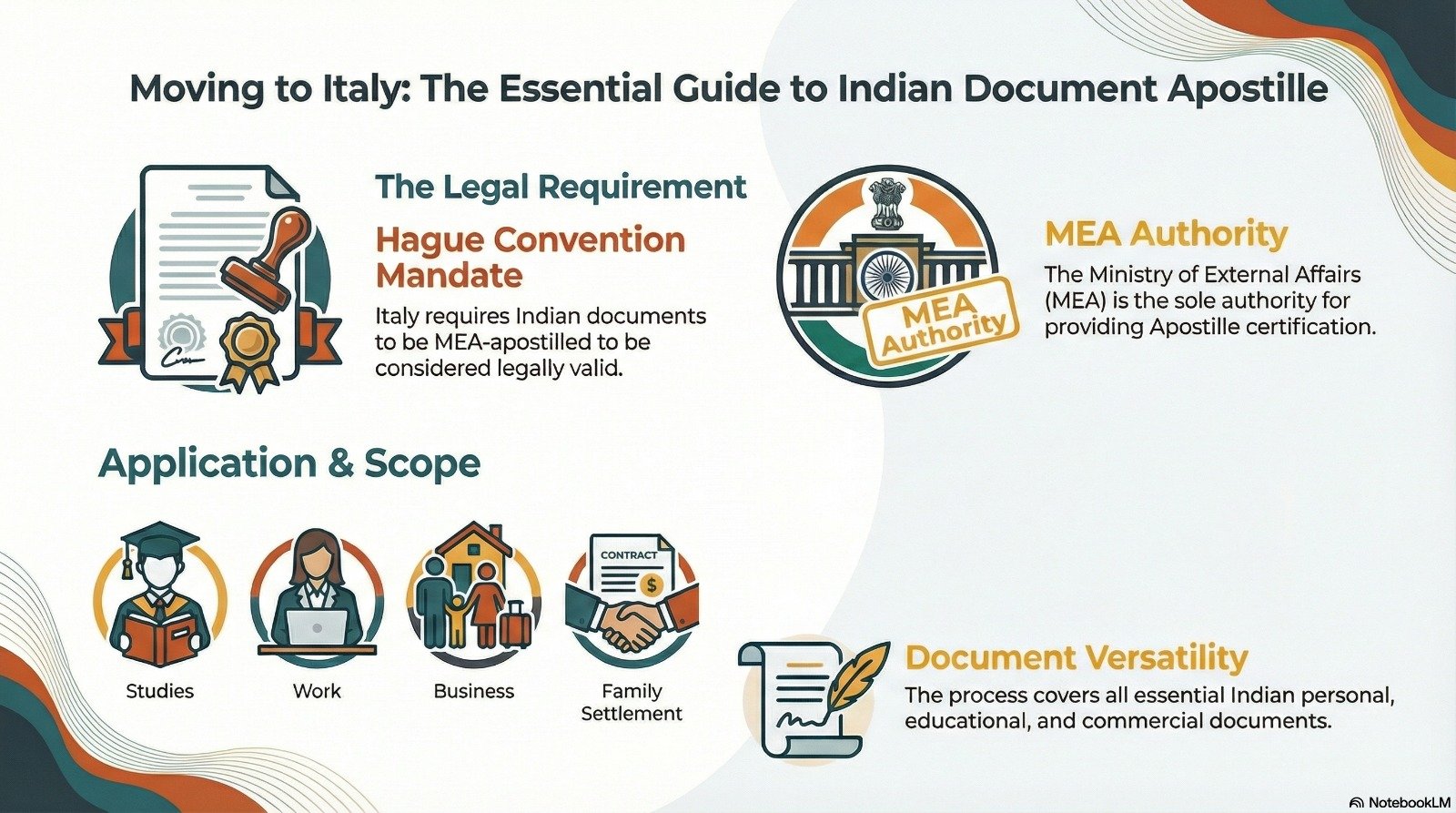
If you are planning to move to Italy for studies, work, business, or family settlement, one essential requirement is Apostille certification of your Indian documents.
Italy is a member of the Hague Convention, which means Indian documents must be apostilled by the Ministry of External Affairs (MEA) to be legally valid in Italy.
In this guide, we explain:
- What Apostille for Italy means
- Documents required
- Step-by-step process
- Timeline
- Common mistakes to avoid
What is Apostille for Italy?
Apostille is an official legalization stamp issued by the Ministry of External Affairs (MEA), Government of India. It authenticates the signature and seal on your document so that it is legally recognized in Italy.
Since Italy is part of the Hague Convention of 1961, Embassy attestation is NOT required. Only MEA Apostille is sufficient.
Without Apostille, your documents will not be accepted by Italian authorities.
When Do You Need an Apostille for Italy?
Apostille is mandatory for:
- Student Visa for Italian Universities
- Work Visa / Employment Permit
- EU Blue Card
- Dependent / Family Visa
- Marriage registration in Italy
- Permanent Residency
- Business setup in Italy
Documents Required for Apostille for Italy
The documents depend on your purpose of travel. Below is the complete list categorized for clarity:
1️⃣ Educational Documents
Required for student visa or employment:
- Degree Certificate
- Diploma Certificate
- Mark Sheets
- Transcripts
- Bonafide Certificate
2️⃣ Personal Documents
Required for family visa, PR, marriage registration:
- Birth Certificate
- Marriage Certificate
- Divorce Certificate
- Police Clearance Certificate (PCC)
- Medical Certificate
- Affidavits
3️⃣ Commercial Documents
Required for business setup:
- Power of Attorney
- Company Incorporation Certificate
- Board Resolution
- Commercial Agreements
- Export Documents
Apostille Process for Italy in India
The process is a structured chain procedure:
Step 1: State Authentication (If Required)
Some documents require authentication from:
- State Home Department (for personal documents)
- HRD Department (for educational documents)
Step 2: MEA Apostille
Once verified, documents are submitted to the Ministry of External Affairs for Apostille stamping.
The MEA places a digital Apostille sticker with a unique identification number.
Step 3: Ready for Use in Italy
After Apostille, documents are legally valid in Italy and can be submitted to:
- Italian Universities
- Italian Immigration Authorities
- Employers
- Municipal Offices
Embassy Attestation is also required on the Italian translated version of the document for Italy.
Timeline for Apostille for Italy
Processing time depends on document type:
| Document Type | Standard Timeline |
| Personal Documents | 2–3 Working Days after attestation from Home Department |
| Educational Documents | 2–3 Working Days after attestation from HRD Department |
| Commercial Documents | 2–3 Working Days after attestation from Chamber of Commerce |
If district or university verification is required, it may take up to 10 to 60 working days depending upon the document.
Urgent processing may be available in certain cases.
Common Mistakes That Cause Delay
Many applicants face rejection or delay because of:
- Laminated documents
- Name mismatch with passport
- Damaged or unclear certificates
- Missing state authentication
- Submitting photocopies instead of originals
Professional handling helps avoid these errors.
Apostille for Italy – Cost Factors
Charges depend on:
- Type of document
- State of issue
- Urgency
- Standalone vs end-to-end service
End-to-end services usually include pickup, verification, MEA, Embassy submission, and secure delivery.
Why Apostille is Important for Italy Student Visa
Italian universities strictly verify:
- Educational authenticity
- Issuing authority legitimacy
- Document consistency
Without Apostille, your admission or visa may be delayed or rejected.
Apostille for Italy Work Visa
Employers in Italy require Apostille to:
- Validate educational qualifications
- Confirm employment certificates
- Verify personal identity documents
It protects against document fraud and ensures legal employment eligibility.
Why Choose Professional Apostille Services?
The Apostille process may seem simple but involves:
- Department coordination
- Correct submission format
- Knowledge of updated MEA protocols
- Proper documentation
Professional assistance ensures:
- Faster processing
- Zero rejection
- Proper documentation
- Safe handling of originals
Final Thoughts
If you are planning to study, work, or settle in Italy, Apostille is not optional — it is mandatory under Hague Convention rules.
Ensuring your documents are properly apostilled saves you time, avoids visa rejection, and ensures smooth processing with Italian authorities.
Frequently Asked Questions – Apostille for Italy
1. Is Apostille mandatory for Italy?
Yes. Italy is a Hague Convention country, so Apostille from MEA India is mandatory for educational, personal, and commercial documents.
2. How long does Apostille for Italy take?
Standard processing takes 2–5 working days. Educational documents may take 3–7 days depending on state verification.
3. Do I need Italian Embassy attestation after Apostille?
Yes. Italy is a Hague Convention member, but MEA Apostille alone is not sufficient. Embassy attestation is required on the Italian translated version of the document.
4. Which documents need an Apostille for Italy student visa?
Degree certificate, transcripts, mark sheets, birth certificate, and PCC are commonly required for Italy student visa.
5. Can I get Apostille in 2–3 days?
Yes, in most cases personal documents can be apostilled within 2–3 working days, depending on document type and state verification.
6. What is the cost of Apostille for Italy?
The cost depends on document type, state of issue, and urgency. Charges vary for educational, personal, and commercial documents.
7. Is Apostille required for Italy work visa?
Yes. Employers in Italy require Apostille on educational and personal documents for employment visa processing.
8. Can laminated documents be apostilled?
No. Laminated documents must be de-laminated before submission. MEA does not accept laminated certificates.